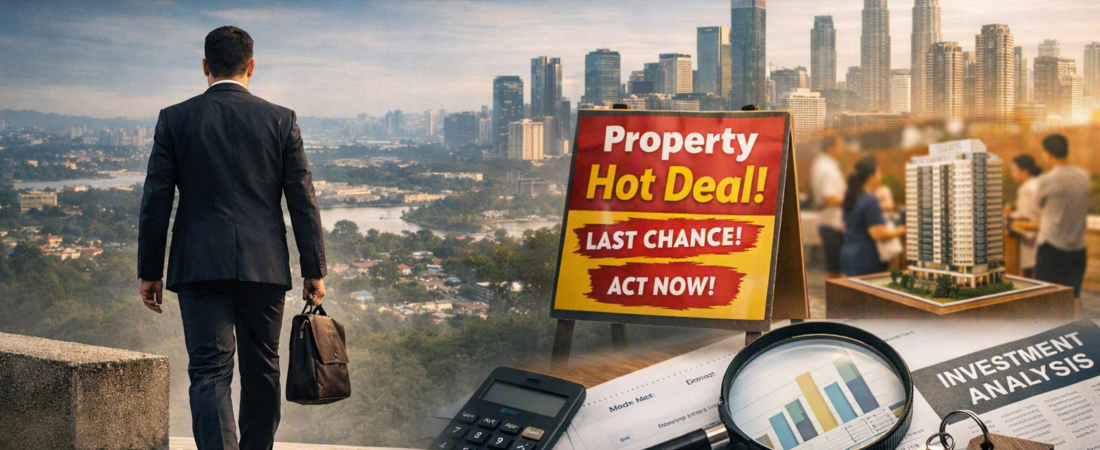
Why Discipline Beats Hype in the Klang Valley
After spending years on the ground navigating the Klang Valley property market—from the high-density launches of the KL City Center to the mature residential pockets of Bangsar, Damansara Heights, Petaling Jaya and Damansara —I have come to a quiet realization.
The most successful property investors are rarely the loudest or most emotional people in the room. They are simply the most disciplined.
In every market cycle, the noise is constant. Social media feeds hype up the “next big hotspot,” artificial urgency fills sales galleries, and the fear of missing out (FOMO) pushes buyers into rapid decisions. But watching how wealth is preserved over decades reveals a stark difference between average buyers and top-tier investors.
What Disciplined Investors Intentionally Ignore
When an average buyer enters a sales gallery, they react to the excitement. When a disciplined investor enters, they filter out the noise. They do not commit capital because:
- “Everyone else is buying” — They know crowd momentum often signals top-of-market pricing rather than value.
- A salesperson creates artificial urgency — They refuse to let manufactured timers override thorough due diligence.
- Social media deems a project “hot” — They recognize that marketing budget does not equal asset quality.
The Core Four: What They Actually Analyze
Instead of buying into the hype, experienced Klang Valley investors strip away the emotion and focus on four unsexy, highly practical metrics:
- True Entry Price: Is the price per square foot realistic relative to existing sub-sale stock in the immediate neighborhood, or is it inflated by developer rebates and luxury fittings?
- Proven Demand Depth: Is there a real, active pool of tenants and end-users in this micro-location today, or is the strategy reliant on speculative future infrastructure?
- Downside Risk: What is the maximum downside if interest rates shift, assessment rates rise, or supply floods the immediate radius?
- Long-Term Holding Ability: Is the financing structured so the asset can withstand prolonged market softness without draining personal liquidity?
The Superpower: Comfort with Walking Away
If there is one trait I admire most in seasoned investors, it is their willingness to walk away from a deal—even an attractive one.
Capital protection is as much a part of investing as capital growth.
Average buyers feel a sense of loss when they walk away from a deal. Disciplined investors know that keeping cash liquid while waiting for the right opportunity is far better than locking capital into a mediocre asset that drains cash flow every month.
The 3 Questions That Test “Survivability”
Whenever a project looks promising on paper, disciplined investors run it through three non-negotiable stress tests:
- “Who is the actual tenant?” Not a vague profile, but the specific demographic—e.g., local medical staff, corporate expats, dual-income young families—and what their budget constraints are.
- “What happens if rental softens by 15%?” Can the yield still cover the bank instalment and maintenance fees, or does it force an out-of-pocket top-up?
- “Can I comfortably hold this for 5 to 7 years through a down-cycle?” Does this asset preserve holding power, or does it create financial anxiety?
Final Thought: Potential vs. Survivability
A good real estate investment isn’t just about headline potential upside. It is about survivability.
In a high-density, highly competitive market like the Klang Valley, the assets that build lasting wealth are the ones engineered to survive market noise, absorb vacancies smoothly, and allow time and compounding to do the heavy lifting.
What do you think separates strong investors from average ones in today’s market?