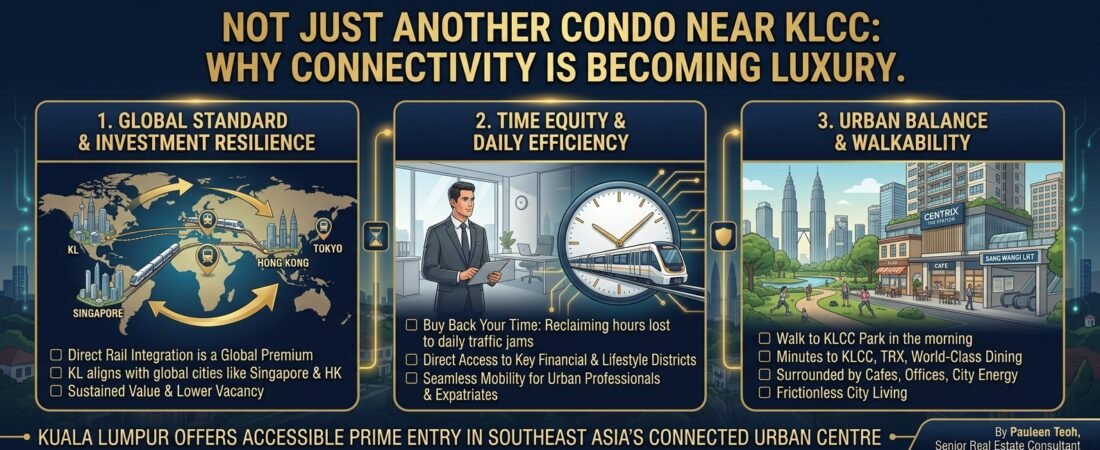
Not Just Another Condo Near KLCC
For decades, real estate marketing in the Kuala Lumpur City Centre (KLCC) corridor focused heavily on surface metrics: grand marble foyers, ultra-high ceilings, and sheer square footage.
However, in my years advising both local investors and international buyers across the Klang Valley, I’ve noticed a fundamental shift in how affluent buyers define value. Today, luxury isn’t merely about the space inside your four walls—it is about frictionless urban living.
Time has become the ultimate scarce commodity. For executive tenants, mobile digital professionals, and global investors, true luxury is daily convenience, lifestyle efficiency, and hyper-connectivity.
The Paradigm Shift: From Vanity Specs to Lifestyle Efficiency
In major global financial hubs like Singapore, Tokyo, London, and Hong Kong, direct integration into mass rapid transit networks is not considered a budget feature; it is the pinnacle of premium residential real estate. Properties integrated with key rail lines command sustained pricing premiums and enjoy consistently lower vacancy rates.
Kuala Lumpur is rapidly aligning with this global trend. While living within the KLCC core provides prestige, relying solely on private vehicular transport in city-centre traffic can quickly erode daily quality of life.
The emerging demand is centered around Transit-Oriented Developments (TODs) that offer:
Time Equity: Reclaiming hours previously lost to daily urban traffic jams.
Seamless Accessibility: Direct, weather-protected access to major financial hubs, medical centers, and lifestyle districts.
Tenant Versatility: High appeal to corporate expatriates, digital nomads, and young executives who prioritize mobility over private car ownership.
The Value Equation: How KL Compares on the Global Stage
When foreign investors evaluate Kuala Lumpur against regional peers, the city-centre equation stands out starkly:
Accessible Entry Pricing: Prime transit-linked residences in KLCC enter the market at a fraction of the cost per square foot compared to Singapore’s Central Core Region (CCR) or central Hong Kong.
Integrated Transit Networks: The Kelana Jaya LRT line acts as the main artery connecting KL’s core employment clusters—stretching from KL Sentral to KLCC, Ampang Park, and Subang.
Walkability & Urban Balance: Being able to take a quick 2-stop train ride to work, walk through KLCC Park in the morning, and enjoy world-class dining in Bukit Bintang without touching a steering wheel is becoming the new gold standard for city living.
What Buyers Must Evaluate?
When analyzing transit-oriented developments in the city centre, remember that location alone is not a guarantee of success. Investors should evaluate three crucial criteria:
Title and Utility Tariff Structure: Understand the difference between commercial SOHO titles and residential tenures, factoring utility rates and holding costs into your gross yield calculations.
Tenant Pool Diversification: Does the unit mix offer flexibility (e.g., dual-key options) to hedge between long-term executive rentals and short-stay hospitality management?
Long-Term Corridor Relevance: Ensure the transit node connects directly to major employment centers (like TRX, KLCC, and KL Sentral) rather than peripheral feeder stations.
A transit-led project shall reflect a broader trend in the Klang Valley property market: investors are moving away from speculative footprint buys and moving toward yield-resilient, location-efficient assets.
When evaluating your next property allocation in the Klang Valley, would you prioritize a larger suburban home with extra space, or fully connected city-centre convenience that buys back your time?